Flat Slabs and Tears: Links between Complex Subduction Geometry and Mantle Dynamics


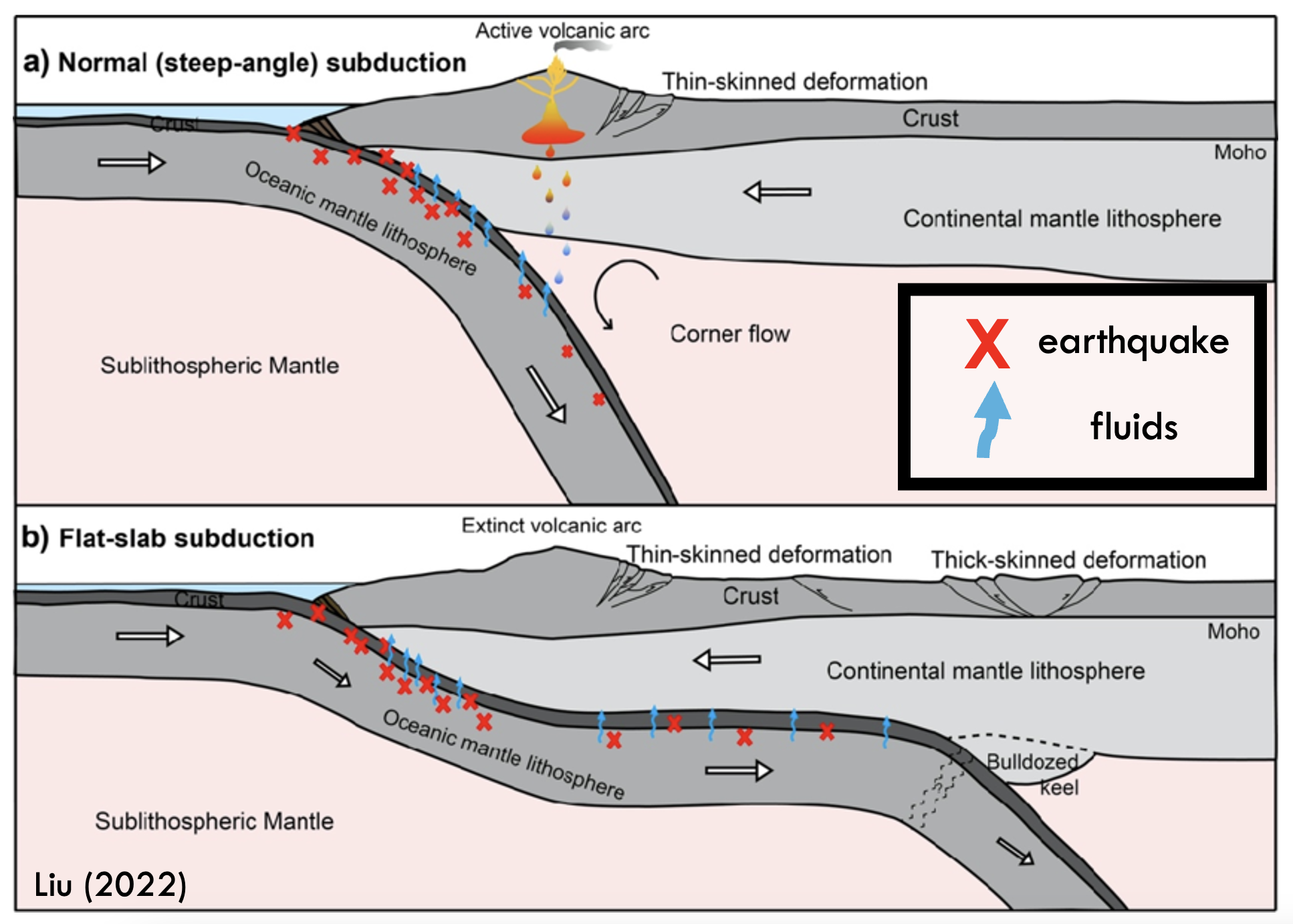
Comparing normal and flat-slab subduction (Modified from Fig. 1.1: Liu, 2022)

Flat-Slab Subduction

Subduction zones around the world exhibit remarkable diversity in slab dip, collision angle, seismicity, and volcanism.

Subduction is a dynamic process. As tectonic plates evolve, slabs may advance or retreat over time. Older, colder, denser slabs tend to sink steeply into the mantle, while younger, warmer, and more buoyant slabs resist sinking.

Slab dip matters. It controls where deformation occurs, where volcanoes form, and how material is recycled back into Earth’s interior.

In the shallowly dipping endmember, known as flat-slab subduction, the descending plate first plows forward for hundreds of kilometers before sinking into the mantle. This unusual geometry pushes deformation and earthquake activity far inland compared to a typical subduction zone. It also chokes off preexisting arc volcanism and redistributes fluids and critical minerals across a much broader region.
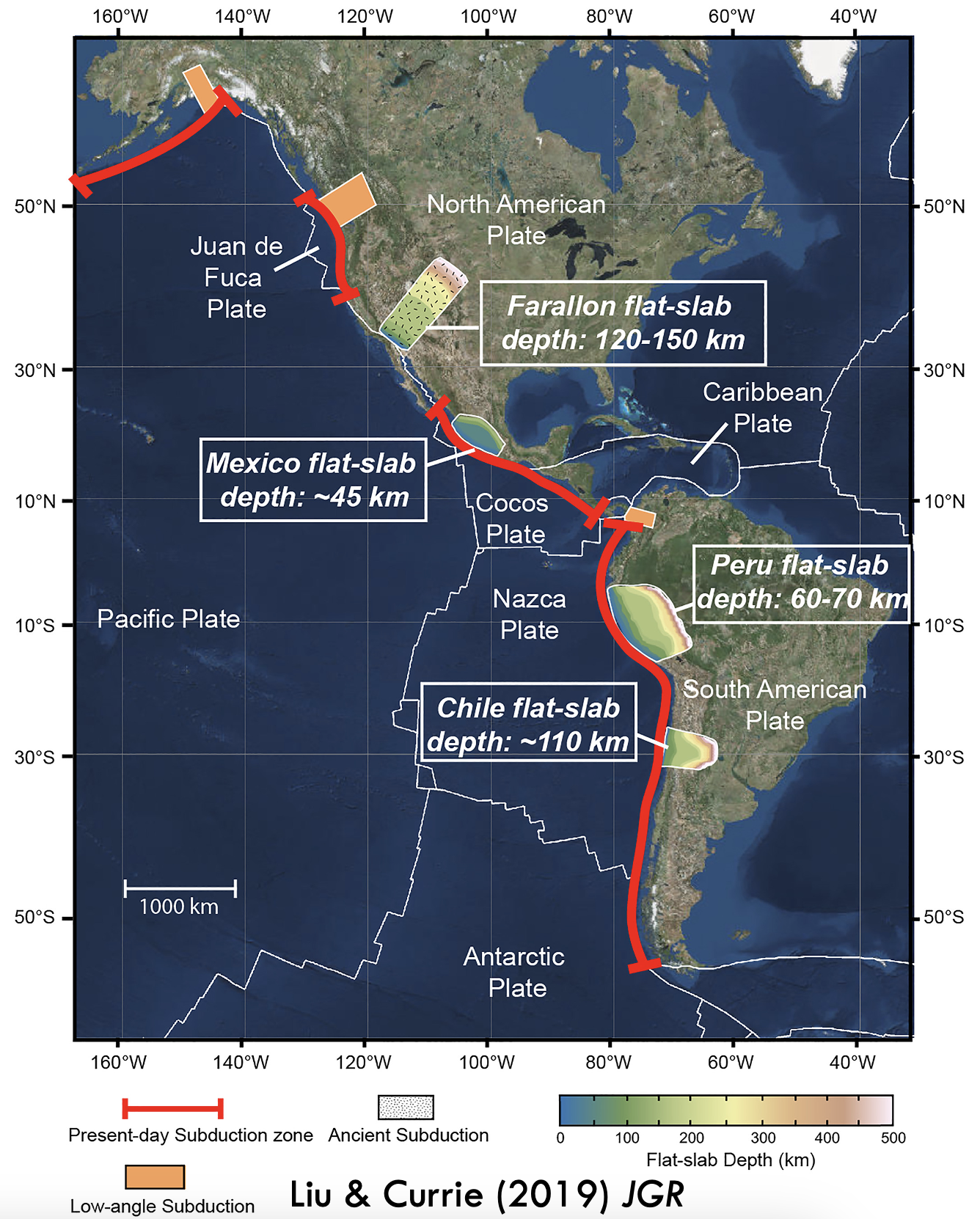
Map of flat slabs. (Liu & Currie, 2019, JGR) Today, flat-slab subduction in a handful of places, including Chile, Peru, Colombia, and Mexico. One of the most dramatic examples in Earth’s history was the Farallon flat slab, which extended nearly to the center of the North American continent. This remarkable subduction geometry is thought to have contributed to the formation of the ancestral Rocky Mountains and the emplacement of the Colorado Mineral Belt. During this episode, even the center of the North American plate was not safe from plate tectonic deformation.

How do mountain belts form hundreds of kilometers from the nearest plate boundary? We cannot travel back in time to observe the Farallon flat slab, but we can search for places that may be undergoing similar processes today. The present is the key to the past.

That brings us to Colombia, the focus of my current research. Colombia provides an exceptional natural laboratory for studying both flat slabs and one of their most intriguing byproducts—slab tears.
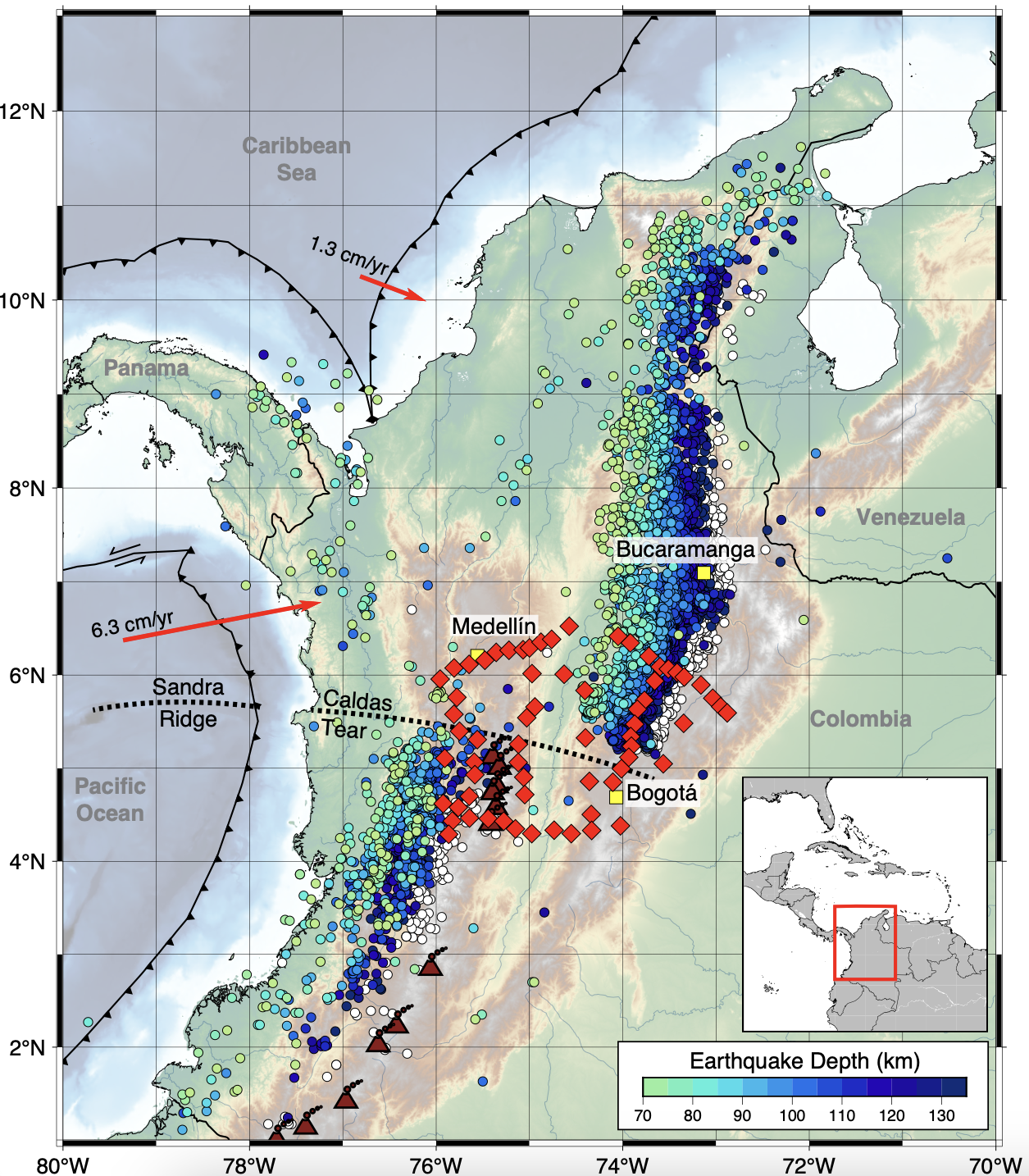
Deployment map of MUSICA seismic stations (Fig. 1: Carchedi et al.,2026).

Cordillera Conundrums in the Northwestern Andes

Northwestern South America is shaped by an unusually complex plate boundary. Along the Pacific coast, the Nazca Plate subducts eastward beneath South America. To the north, the Caribbean Plate also converges with South America from a different direction. This is anything but a textbook subduction zone.

Instead of a single continuous mountain belt, the northern Andes mountains split into three parallel ranges: the Western, Central, and Eastern Cordilleras. Active volcanism closely follows the Western Cordillera south of about 5.5°N before abruptly disappearing farther north.

Without dense seismic arrays, our clearest view of the deep Earth comes from earthquakes occurring within the descending slabs themselves. Because the subducting plates remain relatively cold, they continue to host earthquakes, allowing us to trace their geometry deep beneath the surface.

South of 5.5°N, the Nazca Plate follows a typical steeply dipping geometry beneath an active volcanic arc. Farther north, however, the pattern changes dramatically. Slab seismicity shifts 150-200 kilometers to the east while volcanism simultaneously shuts down. This discontinuity, known as the Caldas Tear, coincides with the subduction of the Sandra Ridge.

Even farther north, another slab begins sinking more than 300 kilometers from the nearest plate boundary. Rather than sinking immediately, it first subducts horizontally for hundreds of kilometers as a flat slab before descending into the mantle.

One intriguing possibility is that these slabs were once connected as a single continuous flat slab. If only the southern portion later sank into the mantle, it would naturally produce the large separation observed today across the Caldas Tear. Although the origin of the northern slab remains debated, the Caldas Tear clearly represents one of the clearest slab discontinuities on Earth.

Why Do Slab Tears Matter?

Slab tears have consequences that extend far beyond slab geometry. As oceanic plates sink, the drive a circulation pattern in the mantle known as corner flow, which helps recycle material through the subduction system. What happens when that flow encounters a giant tear in the slab?

Can mantle flow be diverted sideways through the opening? Can it rise or sink vertically? Where do the fluids responsible for melting, volcanism, and ore formation go? Does this redirected mantle flow push or pull on Earth’s surface? These forces may even deform the landscape itself through a process called dynamic topography.

Understanding how slab tears influence mantle circulation—and how mantle circulation, in turn, influences slab evolution—is one of the central questions motivating my current research.

To investigate these questions, collaborators and I are analyzing seismic data collected by the MUSICA (Modeling, Uplift, Seismicity, and Igneous geochemistry of the Colombian Andes) experiment, a three-year international deployment of 66 broadband seismic stations spanning Colombia.
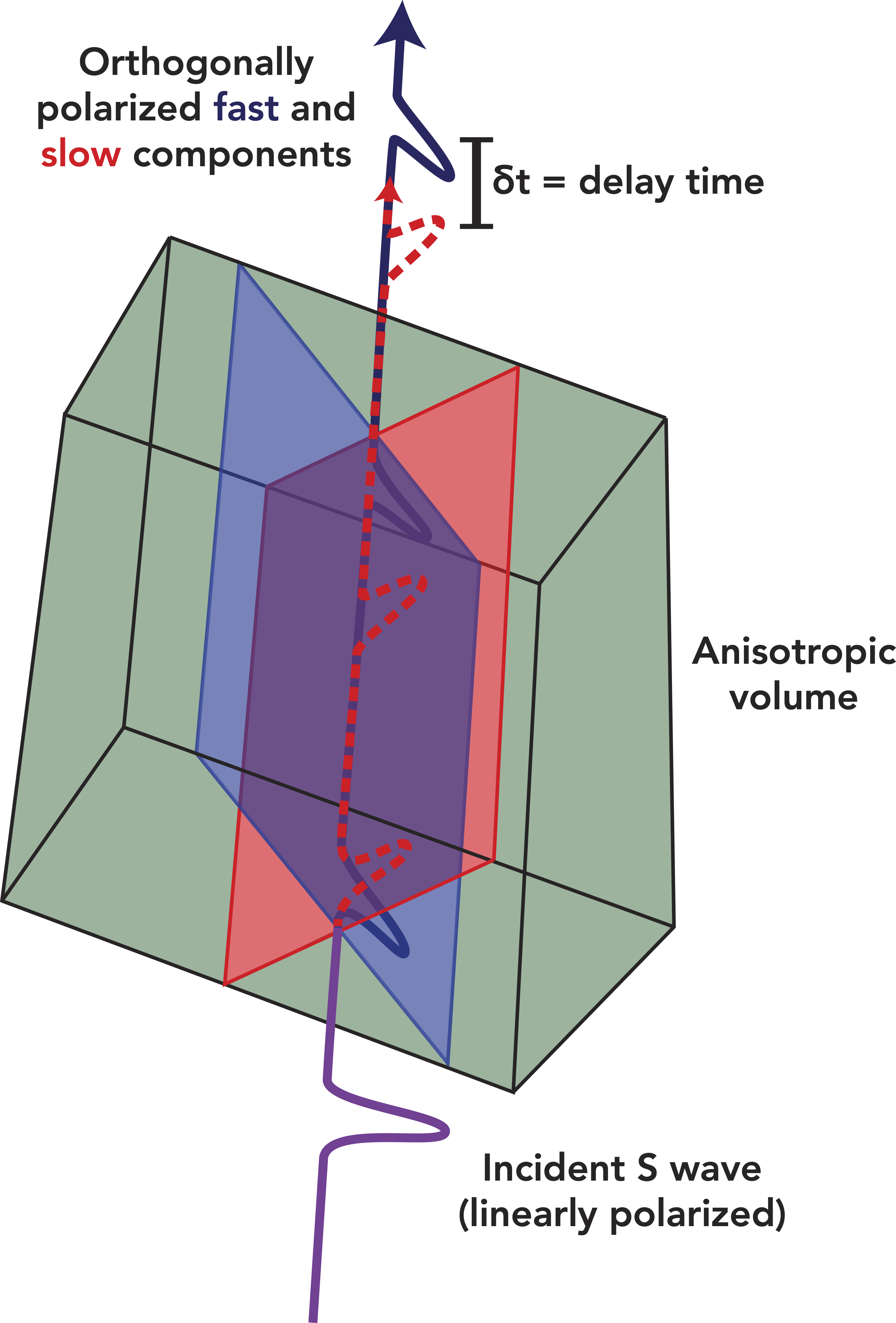
Shear-wave splitting cartoon. (Courtesy of Ed Garnero)

Shear-Wave Splitting

We cannot directly observe mantle flow, but we can observe one of its fingerprints: seismic anisotropy.

Seismic anisotropy is the dependence of seismic wave speed on propagation direction. In other words, seismic waves travel at different speeds depending on the direction in which they move through earth.

One of the most powerful ways to measure anisotropy is by observing shear-wave splitting. Shear waves are body waves that involve particle motion perpendicular to the direction of travel. As they pass through an anisotropic region, they split into fast and slow components, producing a measurable delay time. By measuring both the delay time and the orientation of the fast wave relative to the slow wave, we can infer the orientation and strength of anisotropy within the Earth’s interior.

For this study, we use shear waves that pass through Earth’s liquid outer core. Because liquids cannot transmit shear waves, passage through the outer core effectively resets shear motion. Thus, any splitting observed at the surface must originate in the upward path beneath our seismic stations.

The primary source of anisotropy in subduction zones is mantle olivine, a mineral with intrinsically anisotropic crystal structure. As mantle rocks deform, olivine crystals become aligned with the surrounding deformation. Although this relationship depends on stress, water content, and grain size, (stress in the physical sense: a force acting over an area, though I imagine being deformed at high pressure and temperature must be a stressful experience as well), under typical mantle conditions, the fast direction generally aligns with mantle flow.

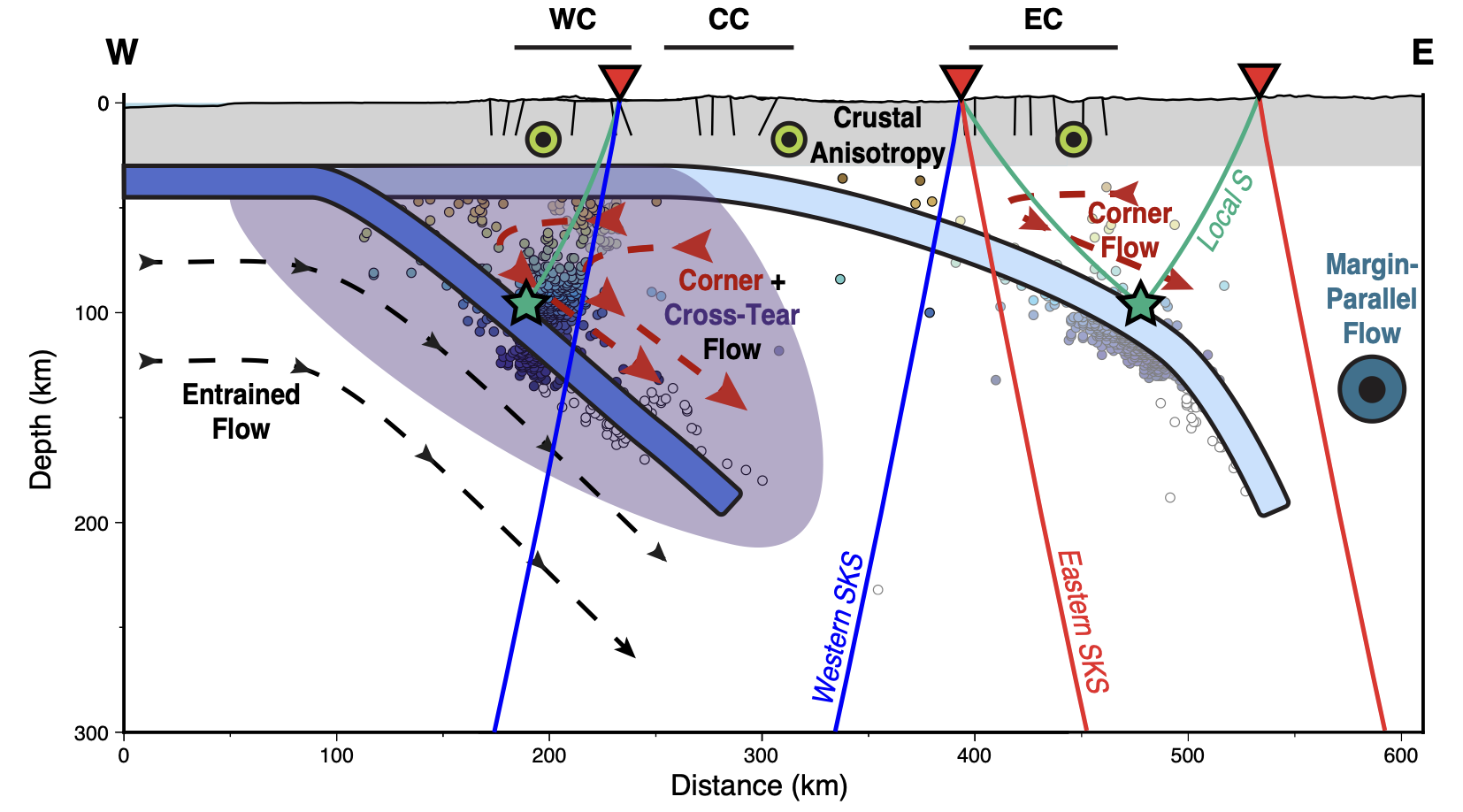
Anisotropy and flow below Northwestern South America.

Results and Next Steps

Thanks to MUSICA’s dense station spacing, we observe complex patterns of seismic anisotropy across Colombia. Rather than a single uniform mantle flow field, our observations reveal three distinct flow regimes: margin-perpendicular corner flow beneath southwestern Colombia, mantle flow redirected through the Caldas Tear in northwestern Colombia, and margin-parallel along-slab farther east. These observations suggest that slab tears fundamentally reorganize mantle circulation over regional scales.

Because shear-wave splitting integrates anisotropy along the entire ray path, however, it cannot uniquely determine the depth of the observed deformation. The next step is therefore to separate the contributions of the overriding plate, mantle wedge, and subducting slabs.

By combining shear-wave splitting from local earthquakes in the slabs with new computational methods capable of imaging three-dimensional anisotropy, we aim to directly map mantle flow through the Caldas Tear and better understand how deep mantle dynamics shape the evolution of Earth’s surface.

Updated August 2026.

Check out our paper to learn more!

Carchedi, CJW., L. Wagner, G. Monsalve, D.S. Avellaneda-Jiménez, and S. Golden (2025). Complex shear-wave splitting behavior and possible implications for mantle flow around the Caldas Tear JGR Solid Earth, 131 (6), e2025JB033131. https://doi.org/10.1029/2025JB033131